Fleur Anderson Welcomes New Online Safety Legislation
Says range of safeguards for children is long-overdue
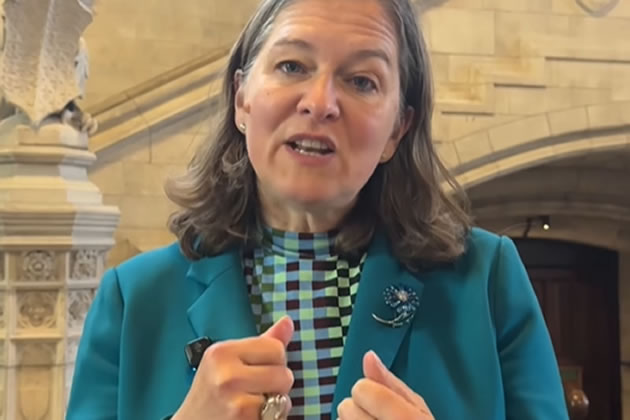 Fleur Anderson in Parliament explaining on social media why she supports restrictions
September 11, 2026
Fleur Anderson MP has welcomed the Labour Government’s decision to introduce new legislation strengthening protections for children online, describing the move as a long-overdue response to the escalating risks of sexual exploitation, grooming and abuse faced by young people.
The measures, announced this week, will make it harder for under-18s to take, view or send nude images, with protections built directly into devices rather than relying on children or parents to navigate complex safety settings. The legislation will also aim to close gaps between apps, platforms and device functions, ensuring safeguards operate consistently across the digital environment while respecting privacy.
The MP for Putney has led a sustained campaign for stronger online protections, arguing that children should not be left to manage risks created by rapidly evolving technology. She said the pace of technological change had “moved faster than the protections available to children” and welcomed the Government’s commitment to reversing that imbalance.
“Children and young people in Putney, Roehampton, Southfields and Wandsworth Town, and across the country, should be able to use technology without being exposed to the risks of sexual exploitation, abuse and grooming,” she said. “Parents and carers should not have to become experts in complicated settings just to keep their children safe. The responsibility must also sit with the companies designing and providing these services.”
She said the evidence on online sexual exploitation was “deeply concerning” and stressed the need to act before harm occurs rather than responding after the fact. “Labour is determined to make the online world safer for children,” she added.
Her concerns were echoed in Parliament by Lisa Nandy, the Secretary of State for Digital, Culture, Media and Sport, who said the Government would not tolerate a crisis of child harm online. “We will give tech companies the chance to lead, but not allow them to lag,” she said. “Planning must now become implementation, and progress must translate into protections that make a real difference in children’s lives. When it comes to children’s safety, we are not and never will be bystanders.”
Recent figures underline the urgency. Last month, the Internet Watch Foundation reported more child sexual extortion-related cases in six months than in the whole of 2025. Its Report Remove service received just 19 sextortion reports in 2022; by 2025, that number had risen to 394. In 2024, the charity found that 91% of online child sexual abuse reports contained self-generated content created by children themselves.
The new measures form part of a wider programme of action by the Government to protect young people online. Planned restrictions will prevent social media companies from offering services to under-16s, while some of the riskiest features — including livestreaming and communication with strangers — will be limited across platforms such as games. Features designed to keep users scrolling, such as auto-play videos and endlessly personalised feeds, will be switched off by default for 16- and 17-year-olds to ensure protections do not fall away as teenagers get older.
The legislation is expected to be developed in the coming months, with ministers signalling that tech companies will be required to deliver meaningful, practical safeguards rather than voluntary or piecemeal measures.
Like Reading Articles Like This? Help Us Produce More This site remains committed to providing local community news and public interest journalism. Articles such as the one above are integral to what we do. We aim to feature as much as possible on local societies, charities based in the area, fundraising efforts by residents, community-based initiatives and even helping people find missing pets. We've always done that and won't be changing, in fact we'd like to do more. However, the readership that these stories generates is often below that needed to cover the cost of producing them. Our financial resources are limited and the local media environment is intensely competitive so there is a constraint on what we can do. We are therefore asking our readers to consider offering financial support to these efforts. Any money given will help support community and public interest news and the expansion of our coverage in this area. A suggested monthly payment is £8 but we would be grateful for any amount for instance if you think this site offers the equivalent value of a subscription to a daily printed newspaper you may wish to consider £20 per month. If neither of these amounts is suitable for you then contact info@neighbournet.com and we can set up an alternative. All payments are made through a secure web site. One-off donations are also appreciated. Choose The Amount You Wish To Contribute. If you do support us in this way we'd be interested to hear what kind of articles you would like to see more of on the site – send your suggestions to the editor. For businesses we offer the chance to be a corporate sponsor of community content on the site. For £30 plus VAT per month you will be the designated sponsor of at least one article a month with your logo appearing if supplied. If there is a specific community group or initiative you'd like to support we can make sure your sponsorship is featured on related content for a one off payment of £50 plus VAT. All payments are made through a secure web site. |