MP Claims Bridge Closure 'Creating Accident Blackspots'
Fleur Anderson makes comments as government unveils road-safety overhaul
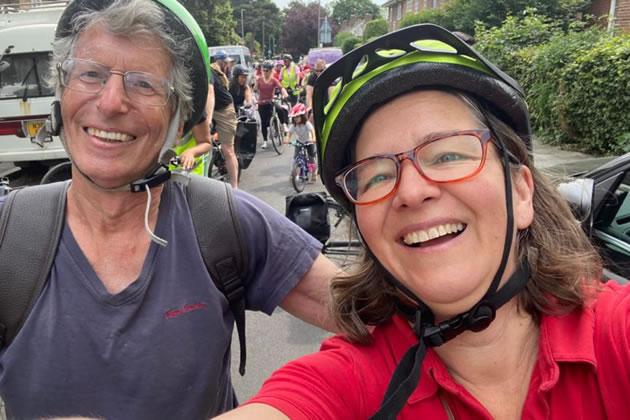
Fleur Anderson (right) says bridge being shut to motor traffic has created more risk for cyclists and pedestrians
January 23, 2026
Putney MP Fleur Anderson has warned that the long-running closure of Hammersmith Bridge is turning key routes in Putney into “accident blackspots”, as she welcomed the Labour Government’s first national Road Safety Strategy in more than a decade.
The strategy, billed by ministers as a long-overdue reset after years of stalled progress, comes amid stark national figures showing that four people are killed on England’s roads every day, with thousands more suffering life-changing injuries. Campaigners have described the past decade as “a lost decade” for road safety, with casualty numbers plateauing despite advances in vehicle technology.
While the national strategy sets the direction for the next decade, she claimed that Putney residents are already living with daily risks exacerbated by the closure of Hammersmith Bridge.
Two fatal incidents in the past 18 months have intensified local concern: the death of a cyclist near the junction of West Hill and Lytton Grove in November 2024, and the death of a pedestrian struck by a lorry near East Putney station in May 2025. It is contended that these tragedies reflect a wider pattern of rising danger on roads that have absorbed displaced traffic from the closed bridge.
According to Ms Anderson, Putney High Street, Putney Bridge and surrounding junctions are now experiencing “dangerous levels of congestion”, with heavy vehicles and rat-running traffic creating conditions that residents describe as “daily hazards”.
“The unresolved situation at Hammersmith Bridge has turned local roads into congestion hotspots and heightened the risk of serious collisions,” she said. “Our community cannot keep bearing the impact of this long-running closure.”
The new strategy sets out a sweeping package of reforms aimed at reducing deaths and serious injuries. Measures include tougher penalties for dangerous driving, a consultation on lowering the drink-drive limit, a strengthened crackdown on drug-driving, and major reforms to driver training and testing. Ministers are also proposing a minimum learning period for new drivers, mandatory high-tech safety features in all new cars, updated road-design standards and an overhaul of national speed-limit guidance.
A new Road Safety Investigation Branch will be established to examine the causes of serious collisions, mirroring the approach used in aviation and rail.
Ms Anderson said the plan “can’t come a moment too soon”, arguing that previous governments had failed to maintain momentum on casualty reduction. “This new strategy finally puts saving lives back at the heart of transport policy,” she said. “It strengthens protections for pedestrians and cyclists, raises safety standards for drivers, and sets out the long-term action we need to make our streets genuinely safer.”
The MP argues that the bridge’s closure is no longer just a transport inconvenience but a direct contributor to road-safety risks. She says local businesses, schools and residents have repeatedly raised concerns about increased journey times, heavier traffic flows and more aggressive driving behaviour on diversion routes.
Ms Anderson is urging residents to join her at a rally at the Barnes end of Hammersmith Bridge at 2pm on 24 January, calling for urgent repairs and a full reopening to traffic.
“I want as many local people as possible to join me and make it clear that Putney must benefit from this renewed national focus on road safety,” she said. “I’ll keep fighting until it does.”
Like Reading Articles Like This? Help Us Produce More This site remains committed to providing local community news and public interest journalism. Articles such as the one above are integral to what we do. We aim to feature as much as possible on local societies, charities based in the area, fundraising efforts by residents, community-based initiatives and even helping people find missing pets. We've always done that and won't be changing, in fact we'd like to do more. However, the readership that these stories generates is often below that needed to cover the cost of producing them. Our financial resources are limited and the local media environment is intensely competitive so there is a constraint on what we can do. We are therefore asking our readers to consider offering financial support to these efforts. Any money given will help support community and public interest news and the expansion of our coverage in this area. A suggested monthly payment is £8 but we would be grateful for any amount for instance if you think this site offers the equivalent value of a subscription to a daily printed newspaper you may wish to consider £20 per month. If neither of these amounts is suitable for you then contact info@neighbournet.com and we can set up an alternative. All payments are made through a secure web site. One-off donations are also appreciated. Choose The Amount You Wish To Contribute. If you do support us in this way we'd be interested to hear what kind of articles you would like to see more of on the site – send your suggestions to the editor. For businesses we offer the chance to be a corporate sponsor of community content on the site. For £30 plus VAT per month you will be the designated sponsor of at least one article a month with your logo appearing if supplied. If there is a specific community group or initiative you'd like to support we can make sure your sponsorship is featured on related content for a one off payment of £50 plus VAT. All payments are made through a secure web site. |