Putney MP Hails Removal of Wet Wipe Island
180-tonnes of waste near Hammersmith Bridge altered course of river
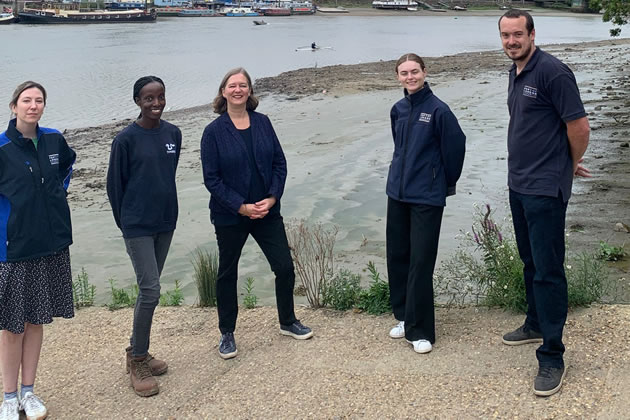 Fleur Anderson (centre) with volunteers near Wet Wipe Island
August 8, 2025
Putney’s MP, Fleur Anderson has hailed a major environmental clean-up currently underway on the River Thames, as work begins to remove the notorious “Wet Wipe Island” near Hammersmith Bridge. The mass excavation, coordinated by the Port of London Authority (PLA) with support from Thames Water, marks the UK’s first large-scale removal of congealed wet wipes from a riverbed. The island, formed by an estimated 180 tonnes of plastic-laced wipes, has altered the river’s course and posed a threat to aquatic life along a 250-metre stretch of the tidal Thames.
The island, which is about the size of two tennis courts, is expected to take around a month to completely clear.
Ms Anderson described the clean-up as a “huge moment” after years of campaigning. “Wet Wipe Island hopefully is no more,” she said. “The ban I’ve introduced will mean 3.8 billion wipes removed from the network every year. A win for our waters, sewers and environment!”
Her campaign to ban plastic in wet wipes began in 2021 and has garnered cross-party support, as well as backing from environmental groups and retailers like Boots and Tesco, which have already removed plastic wet wipes from their shelves. Her efforts culminated in government legislation to ban plastic in wet wipes, a move she says will have a direct impact on the Thames, especially in areas like Putney where combined sewer overflows have long been a concern.
The clean-up operation will use an eight-tonne excavator to remove the island during low tide. St Paul’s School in Barnes is providing access to its grounds for the machinery, and the waste will be responsibly disposed of. The project is part of the PLA’s Clean Thames Manifesto, which aims for a pollution-free river ecosystem by 2050.
Thames21, the environmental charity whose volunteers have monitored the site since 2017, played a pivotal role in raising awareness and gathering data that influenced both government policy and the clean-up strategy. CEO Chris Coode praised the move, calling it “a crucial step towards protecting the health of the River Thames and its wildlife.”
The PLA’s Director of Sustainability, Grace Rawnsley, said, “For too long, ‘Wet Wipe Island’ in Hammersmith has been a source of environmental harm and an embarrassment to the capital. Inspired by the work of volunteers at Thames 21, we decided to take a lead in co-ordinating action to remove this unsightly and harmful mess.
“This is the first time anyone has sought to execute a mass, mechanical removal of wet wipes in this way.
Like Reading Articles Like This? Help Us Produce More This site remains committed to providing local community news and public interest journalism. Articles such as the one above are integral to what we do. We aim to feature as much as possible on local societies, charities based in the area, fundraising efforts by residents, community-based initiatives and even helping people find missing pets. We've always done that and won't be changing, in fact we'd like to do more. However, the readership that these stories generates is often below that needed to cover the cost of producing them. Our financial resources are limited and the local media environment is intensely competitive so there is a constraint on what we can do. We are therefore asking our readers to consider offering financial support to these efforts. Any money given will help support community and public interest news and the expansion of our coverage in this area. A suggested monthly payment is £8 but we would be grateful for any amount for instance if you think this site offers the equivalent value of a subscription to a daily printed newspaper you may wish to consider £20 per month. If neither of these amounts is suitable for you then contact info@neighbournet.com and we can set up an alternative. All payments are made through a secure web site. One-off donations are also appreciated. Choose The Amount You Wish To Contribute. If you do support us in this way we'd be interested to hear what kind of articles you would like to see more of on the site – send your suggestions to the editor. For businesses we offer the chance to be a corporate sponsor of community content on the site. For £30 plus VAT per month you will be the designated sponsor of at least one article a month with your logo appearing if supplied. If there is a specific community group or initiative you'd like to support we can make sure your sponsorship is featured on related content for a one off payment of £50 plus VAT. All payments are made through a secure web site. |