Research Suggests Parts of Roehampton Becoming Gentrified
Average incomes increase much faster than London average
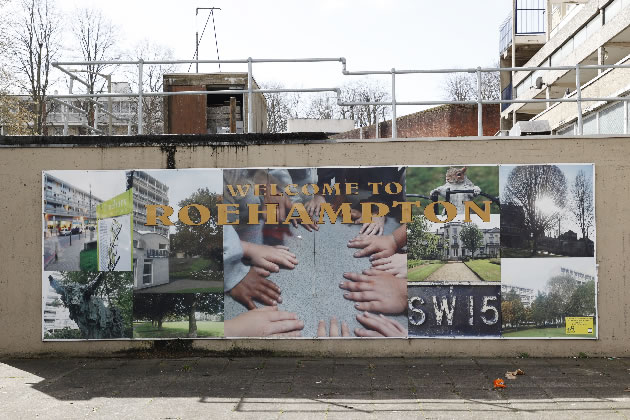
Welcom to Roehampton sign. Picture: Facundo Arrizabalaga/MyLondon
April 4, 2025
New research has revealed that Roehampton is one the London neighbourhoods which have gentrified most rapidly over the last decade.
The analysis, published by the Trust for London charity, looked at the areas the most extreme changes in average incomes between 2012 and 2020.
On average, the 53 council ward areas identified in the research saw average incomes increase by 11 per cent, compared with a one per cent rise seen across the rest of London – after inflation is taken into account.
The area designated as Roehampton North West saw the 44th largest rise across London. However, the income rise was not across the board in the area as Roehampton South and Putney Vale remained in the bottom fifth over the eight-year period. Roehampton North East was not in the bottom quintile for income either in 2012 or 2020.
The report does not go into the specifics of why incomes have risen in this area but a local estate agent says that it has benefited from proximity to Putney and Richmond where properties have risen to the extent that it has offered a more affordable alternative. The expansion of the university and its growing reputation is also believed to have helped as has better bus links to nearby train services. Although the council’s planned redevelopment of the Alton Estate has been a stop-start affair, the prospect of investment in the area has encouraged people to move there.
The largest jumps in income were seen in Spitalfields, which saw a 45 per cent rise in residents’ pay, Aldgate, with a 29 per cent increase, and Bethnal Green South, at 27 per cent. All three are found in the borough of Tower Hamlets, which was found to be the most gentrified borough as it contains 12 of the 53 neighbourhoods.
The analysis was focused only on areas which in 2012 were found in the lowest 20 per cent of average incomes in London. Many of the areas in that lowest 20 per cent have not gentrified to the same extent, and are therefore not included in the 53 identified neighbourhoods.
In its research, produced in partnership with the WPI Economics consultancy, the Trust defined gentrification as “the influx of more affluent residents in lower income areas, relative to the residents that were already there, and the displacement of the previous population”.
The analysis found that in the 53 gentrified places, there was a “remarkable” decrease of almost two percentage points in the proportion of black people living in them, despite the fact that London’s black population remained essentially static between 2012 and 2020.
This equates to “around 10,000 black Londoners that we would see living in these 53 neighbourhoods if the proportion had stayed the same”, the research states.
Although the white population in the gentrified areas fell by a larger amount (more than four per cent), this was still a smaller fall than in the rest of London (about six per cent).
The 53 gentrified areas also saw increases (on average more than two per cent) in the proportion of couples without children. The analysis explains that “one of the biggest threats of gentrification is that it makes London so expensive families can no longer afford to raise children here”.
This trend has also been reflected in the decline of primary school applications in the capital, particularly in inner London, and in the recently confirmed closure of the maternity unit at the Royal Free Hospital in north London.
The research similarly identified an average fall of around five per cent in the number of households living in social-rented homes in the 53 gentrified areas, significantly more than the one per cent fall seen across the rest of London. The gentrified neighbourhoods also saw a rise in the number of people working in managerial positions.
Manny Hothi, the Trust’s chief executive said: “This research points to something that many Londoners have suspected for years – the city is becoming increasingly unaffordable for low-income families. We’re witnessing families and long-standing communities being priced out on a scale we haven’t seen before.
“London’s diverse blend of communities is what makes it one of the best cities in the world. But the current trend shows the city is at a tipping point, at risk of being a homogenous place where only people above a certain income bracket can afford to be.
“If we want London to be a city where people from all backgrounds, of all ages, can live and thrive, urgent action is needed to address the affordability crisis.”
Guy Weir, head of data insights at WPI Economics, added: “Getting under the skin of local area data is key to understanding what’s happening beneath the headlines. As this analysis shows, several London neighbourhoods changed dramatically between 2012 and 2020, with the available data pointing towards a displacement of those on lower incomes.
“While the overall poverty rate has declined across the capital, analysis like this highlights that beneath the surface, communities across the city are struggling to afford to live in London.”
Like Reading Articles Like This? Help Us Produce More This site remains committed to providing local community news and public interest journalism. Articles such as the one above are integral to what we do. We aim to feature as much as possible on local societies, charities based in the area, fundraising efforts by residents, community-based initiatives and even helping people find missing pets. We've always done that and won't be changing, in fact we'd like to do more. However, the readership that these stories generates is often below that needed to cover the cost of producing them. Our financial resources are limited and the local media environment is intensely competitive so there is a constraint on what we can do. We are therefore asking our readers to consider offering financial support to these efforts. Any money given will help support community and public interest news and the expansion of our coverage in this area. A suggested monthly payment is £8 but we would be grateful for any amount for instance if you think this site offers the equivalent value of a subscription to a daily printed newspaper you may wish to consider £20 per month. If neither of these amounts is suitable for you then contact info@neighbournet.com and we can set up an alternative. All payments are made through a secure web site. One-off donations are also appreciated. Choose The Amount You Wish To Contribute. If you do support us in this way we'd be interested to hear what kind of articles you would like to see more of on the site – send your suggestions to the editor. For businesses we offer the chance to be a corporate sponsor of community content on the site. For £30 plus VAT per month you will be the designated sponsor of at least one article a month with your logo appearing if supplied. If there is a specific community group or initiative you'd like to support we can make sure your sponsorship is featured on related content for a one off payment of £50 plus VAT. All payments are made through a secure web site. |