Bus Performance Continues to Improve at Putney Bridge Junction
New data shows marginal reduction in journey times on local routes
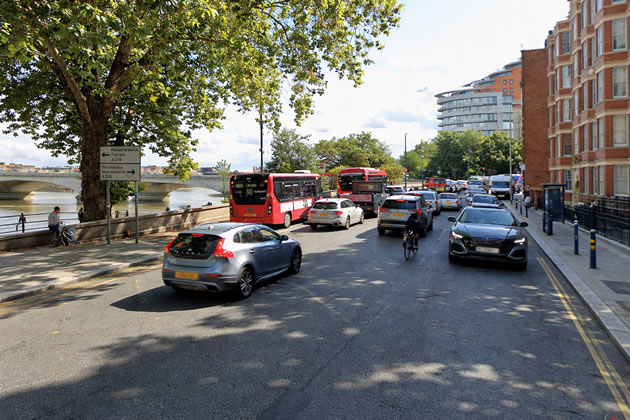
Before changes at Lower Richmond Road approach to junction
April 2, 2026
The most recent data on bus journey times in Putney seems to confirm council claims of a recent improvement. However, speed remain well below what they were before the junction changes around Putney Bridge junction.
An updated Freedom of Information request to Transport for London has provided a detailed picture up to 20 March, after changes were introduced to try and mitigate the delays which have resulted from changes to priority first introduced by the council in September 2024.
Since the council commissioned its redesign of the Putney Bridge junction, weighted average journey times on the Lower Richmond Road eastbound corridor during the morning peak increased by nearly four times from roughly seven minutes per kilometre to nearly 27.
The picture on Putney High Street northbound in the evening peak told a different, but equally concerning story. Journey times there were already rising from 2022 onwards — well before any works began. The scheme then pushed times to around 17 minutes per kilometre by mid-2025: not quite the catastrophic peak seen on the morning corridor on Lower Richmond Road, but a serious degradation in a direction that affects thousands of commuters returning from central London each evening.
Bus Journey Times - Lower Richmond Road eastbound (AM)
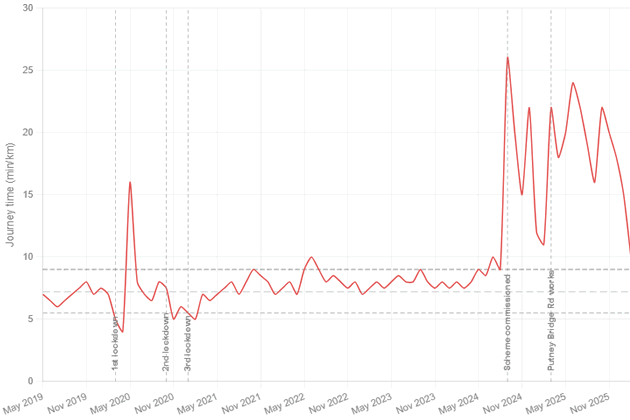
Source: TfL
The latest data does indicate that journey times on both corridors are declining from these peaks starting to fall from last Autumn and continuing so far this year with more rapid improvements recently. This drop has happened at a time when the Albert Bridge has closed which might have been expected to add some extra pressure around this junction.
Bus Journey Times - Putney High Street northbound (PM)
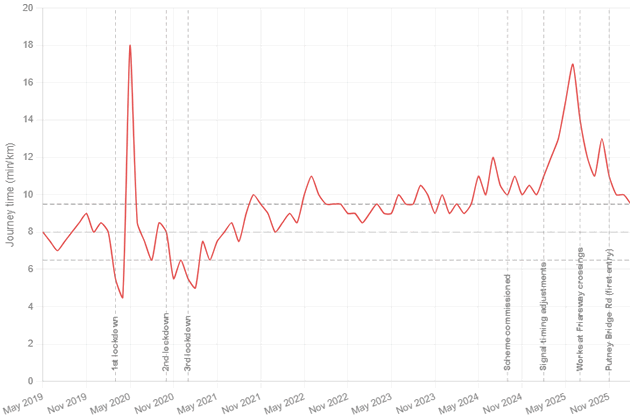
Source: TfL
The stated aim of the £1 million junction redesign was to improve safety for cyclists and pedestrians at Putney Bridge and reduce a traffic bottleneck that had long plagued the junction. New cycle lanes were installed, pedestrian islands enlarged, traffic signals upgraded, and the approach from Lower Richmond Road to the bridge was reduced from two lanes to one.
Route 22 connects Putney Common to Oxford Circus via Putney Bridge and Chelsea, making it the most heavily used of the affected services. Routes 209 and 265 serve the Barnes–Putney Bridge corridor directly. Routes 33, 72 and their night counterparts use Putney Bridge as a diversion corridor following the ongoing closure of Hammersmith Bridge, meaning disruption here compounds an already constrained network.
The council insists the scheme was approved by TfL after thorough traffic modelling. But that modelling has since been questioned: the data used was collected just before the end of the Covid lockdown in July 2021 and, critically, assumed that Hammersmith Bridge would reopen by 2026. With Hammersmith Bridge still closed, the council has explained that Putney Bridge carries significantly more cross-river traffic than the models anticipated, and the lane reduction proved catastrophic for flow.
Lower Richmond Road eastbound in the morning peak is made up of inbound commuter flow towards central London and it experienced the most extreme degradation. This is because the bottleneck at Putney Bridge creates queuing on the southern approach, exactly where the lane reduction was concentrated. Buses joining from Lower Richmond Road were forced into a single-lane queue behind general traffic, with no priority mechanism capable of extracting them.
The result was a queue that regularly stretched back along Lower Richmond Road and into the surrounding residential streets, blocking the very bus routes the scheme was meant to benefit. A council report admitted in November 2024 that the changes had caused "unexpected congestion" and that the authority was "extremely concerned." An independent review confirmed the finding. Meanwhile, 91% of residents in a survey said the scheme had made their journeys worse.
Putney High Street northbound in the evening peak represents the same commuter journey in reverse. Here the congestion, while real, was measurably less severe at its worst. Traffic dispersing northbound across the bridge and into the wider Fulham road network has more downstream outlets, softening — though not eliminating — the queuing effect.
Since late 2024, the council and TfL have introduced a rolling programme of remedial measures: reopening the southbound bus lane in November 2024, extending bus lane operating hours on Putney Bridge Road to seven days, installing double yellow lines to prevent illegal loading, adjusting signal timing allocations to give Lower Richmond Road more green time, and — as recently as March 2026 — realigning the kerb opposite TK Maxx on Putney High Street to allow traffic to pass stationary buses.
The journey time data does show the beginning of a recovery. On the Lower Richmond Road AM corridor, the extreme peaks of 25–27 min/km seen in late 2024 and early 2025 have receded. By early 2026, times appear to be pulling back towards 10–15 min/km — still well above the historic baseline of 7 min/km. The council's own scrutiny papers, published in February 2026, acknowledge "reduced bus journey time since September 2025" while noting that work continues.
Recovery is underway but incomplete. Journey times on both corridors remain materially above their pre-scheme baselines as of early 2026. The pace of improvement is slow relative to the scale of the disruption caused, and several significant works — including the TK Maxx pinch point resolution and further signal changes — were still incomplete.
Fleur Anderson MP explaining the changes in the town centre
For users of route 22 — one of London's busiest orbital bus routes, connecting Putney Common to Oxford Circus via Chelsea and Knightsbridge — the disruption has meant that a bus scheduled to reach Putney Bridge in a predictable time could, on the worst days of 2024 and early 2025, take nearly four times as long to cover the same kilometre of road. At that level of delay, scheduled headways collapse: buses arrive in bunches rather than evenly spaced, and passengers face either very long waits or overcrowded vehicles when a clutch of buses finally breaks through the congestion together.
Routes 33, 72, N22 and N72 face a compounding problem. All four use Putney Bridge as a diversion corridor because Hammersmith Bridge — closed since 2020 — remains unavailable. The failure of the Putney Bridge junction therefore does not merely degrade one corridor: it degrades the substitute route that was created to compensate for an entirely separate piece of infrastructure being out of service. Until Hammersmith Bridge reopens, any sustained congestion at Putney Bridge will continue to have an outsized effect on south-west London's bus network.
On Putney High Street northbound, the evening picture is similarly mixed. The spike of mid-2025 has eased, but times remain elevated relative to the pre-scheme period and the underlying structural pressure on that corridor — the creeping degradation that predates the works entirely — has not been resolved by any of the remedial measures taken so far.
The council is still realigning kerbs and working on lane reassignments outside Putney Station, with further works due to complete in May 2026 which the council hopes will continue to result in journey time reduction.
Like Reading Articles Like This? Help Us Produce More This site remains committed to providing local community news and public interest journalism. Articles such as the one above are integral to what we do. We aim to feature as much as possible on local societies, charities based in the area, fundraising efforts by residents, community-based initiatives and even helping people find missing pets. We've always done that and won't be changing, in fact we'd like to do more. However, the readership that these stories generates is often below that needed to cover the cost of producing them. Our financial resources are limited and the local media environment is intensely competitive so there is a constraint on what we can do. We are therefore asking our readers to consider offering financial support to these efforts. Any money given will help support community and public interest news and the expansion of our coverage in this area. A suggested monthly payment is £8 but we would be grateful for any amount for instance if you think this site offers the equivalent value of a subscription to a daily printed newspaper you may wish to consider £20 per month. If neither of these amounts is suitable for you then contact info@neighbournet.com and we can set up an alternative. All payments are made through a secure web site. One-off donations are also appreciated. Choose The Amount You Wish To Contribute. If you do support us in this way we'd be interested to hear what kind of articles you would like to see more of on the site – send your suggestions to the editor. For businesses we offer the chance to be a corporate sponsor of community content on the site. For £30 plus VAT per month you will be the designated sponsor of at least one article a month with your logo appearing if supplied. If there is a specific community group or initiative you'd like to support we can make sure your sponsorship is featured on related content for a one off payment of £50 plus VAT. All payments are made through a secure web site. |