Decision Time Approaches for Alton Estate Masterplan
Residents hopeful of progress after years of inertia
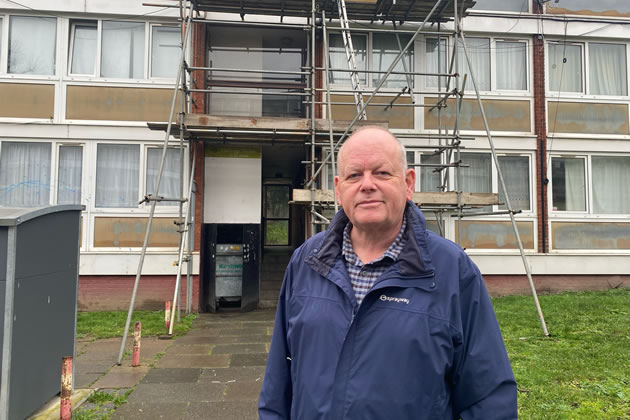
Angus Robertson on the Alton Estate
September 2, 2025
Hopeful residents are preparing to vote on the fate of the Alton Estate, which is finally nearing a decision for its redevelopment after years of uncertainty and delays.
Fresh plans to transform the housing in Roehampton, will go to ballot later this month – 13 years after its regeneration was first agreed by Wandsworth Council’s previous Conservative administration.
Under the latest £100million masterplan, 167 flats on the 1950s estate would be demolished for 614 new ones – including 57 per cent affordable housing. There would be a net increase in social housing, although the exact figure has not yet been confirmed.
A new community hub with a library, council offices and youth services would be built by the entrance to the estate. Its retail parade along Danebury Avenue would be replaced to include a bigger supermarket than the former Co-op store.
A new family hub would also be built at the centre of the development with a relocated nursery, GP surgery and other community services. The estate would get a new public square, outdoor spaces and pedestrian routes.
It was in 2012 that the council’s old Conservative administration originally agreed to regenerate the estate. In 2019, the authority submitted a planning application to demolish 288 flats for 1,108 new flats overall – with just 261, or 24 per cent, affordable homes. These plans were approved in January 2022.
But the scheme was abruptly pulled before building had begun when Labour took control of the council for the first time in 44 years that May, over its lack of affordable housing. The council went back to the drawing board and has since been putting together revised proposals in consultation with residents, which are now nearing a decision.
The council’s new masterplan proposes a higher level of affordable housing, improved community facilities and a replacement shopping parade. It sets out a general vision for the revised scheme, which will be given more detail in a formal planning application if it passes the ballot.
Angus Robertson, who moved onto the estate in 2003, has closely engaged with the plans as they have come forward over the years. He told the Local Democracy Reporting Service (LDRS) the new administration had engaged far better with the community and the revised masterplan was “designed much more with local people’s interests at heart”.
Mr Robertson said, “The proposals as they stand, in my own view, are much stronger than what we had before. They’re much better in terms of creating more social housing, better community facilities, refurbishing some of the homes rather than mass demolition. So… in the general principles of what they’re trying to do, I think a lot of people have seen them as more positive than the old masterplan from the previous administration.”
He added, “I feel at least there has been a lot of input from a wide range of people and a lot of opportunities for people to give their views and a clear process by which those views have been taken forward, or not taken forward sometimes because they weren’t realistic, but a much better partnership and dialogue about developing the plans together.”
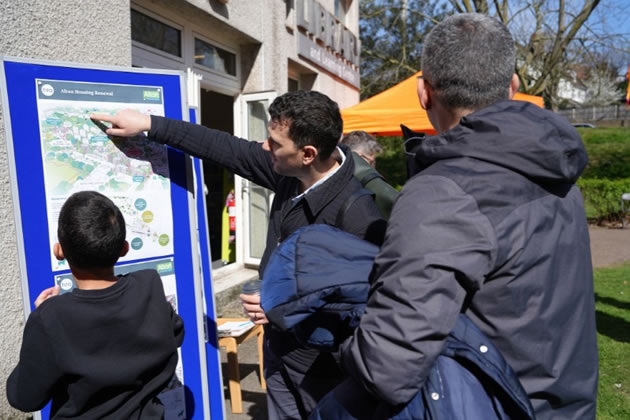
Alton Estate residents check out the latest plan. Picture: Wandsworth Council
The council set up a community panel of residents, officers and architects earlier this year, who regularly meet to review and make decisions on different aspects of the regeneration.
Mr Robertson told the LDRS he felt residents were “in a much better position” than before, but stressed the council must keep properly involving the community to rebuild trust with locals. He called for the authority to carry out a social impact assessment to explore and mitigate the effects of the redevelopment on people’s daily lives, which the council confirmed it plans to do.
The resident said, “A lot of people have been cynical about whether the development will ever happen because it’s been so long and there’s still a lot of that where people say, is it really going to happen? So if we get past this milestone of people voting for the proposals and it becomes real, then I think it’s very important for the council to try and take local people with them and show that they’re listening to their concerns about the day-to-day impact on people’s lives.”
A recent viability study commissioned by the council reported that a suitable regeneration scheme could be delivered at a net cost of around £100million.
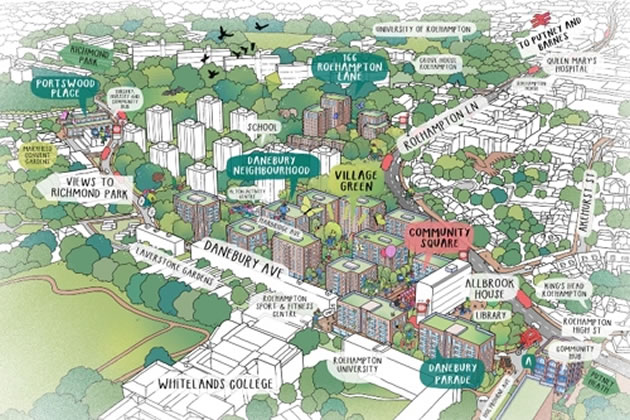
Aerial drawing of Alton proposals
Labour councillor Aydin Dikerdem, Cabinet Member for Housing, said, “Our new plan for the Alton estate has been shaped by many conversations with residents who have taken time to engage with the plans and give us their insight.
“We share local excitement about all the positive opportunities that will come from the new proposals – including new homes, bigger and better community spaces and shops, and easier movement around the estate for everyone. It’s really important for us that the final decisions on the Alton estate are made by residents.
“We know any regeneration has real-life implications for the people who live here so we will be working hard to manage these throughout, as well as commissioning a formal social impact assessment. Our teams are also on hand with clear information and drop-in sessions to answer residents’ questions as they get ready to vote in the ballot in September.”
The resident ballot will be open from 22 September to 16 October.
Charlotte Lilywhite - Local Democracy Reporter
Like Reading Articles Like This? Help Us Produce More This site remains committed to providing local community news and public interest journalism. Articles such as the one above are integral to what we do. We aim to feature as much as possible on local societies, charities based in the area, fundraising efforts by residents, community-based initiatives and even helping people find missing pets. We've always done that and won't be changing, in fact we'd like to do more. However, the readership that these stories generates is often below that needed to cover the cost of producing them. Our financial resources are limited and the local media environment is intensely competitive so there is a constraint on what we can do. We are therefore asking our readers to consider offering financial support to these efforts. Any money given will help support community and public interest news and the expansion of our coverage in this area. A suggested monthly payment is £8 but we would be grateful for any amount for instance if you think this site offers the equivalent value of a subscription to a daily printed newspaper you may wish to consider £20 per month. If neither of these amounts is suitable for you then contact info@neighbournet.com and we can set up an alternative. All payments are made through a secure web site. One-off donations are also appreciated. Choose The Amount You Wish To Contribute. If you do support us in this way we'd be interested to hear what kind of articles you would like to see more of on the site – send your suggestions to the editor. For businesses we offer the chance to be a corporate sponsor of community content on the site. For £30 plus VAT per month you will be the designated sponsor of at least one article a month with your logo appearing if supplied. If there is a specific community group or initiative you'd like to support we can make sure your sponsorship is featured on related content for a one off payment of £50 plus VAT. All payments are made through a secure web site. |