Government Minister Announces New Water Policy in Putney
Steve Reed outlines plans at the Thames Rowing Club
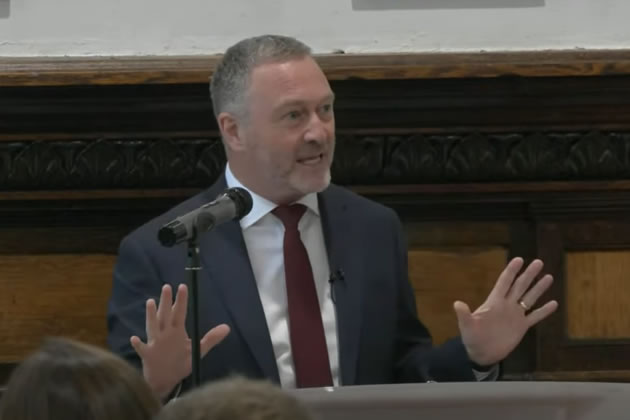
Steve Reed gives a speech at the Thames Rowing Club. Picture: Facebook
|
September 6, 2024
The new Labour government has chosen a Putney rowing club as the venue to announce its plans for cleaning up the country’s rivers, lakes and seas.
This Thursday (5 September) Steve Reed, the Secretary of State at the Department for Environment, Food and Rural Affairs, gave a speech at the Thames Rowing Club outlining a range of new enforcement powers announced on the same day.
In attendance were representatives from the water industry, investors, environmental groups and campaigners.
The Water (Special Measures) Bill has been introduced to parliament with the aim of giving regulators new powers to take tougher and faster action to crack down on water companies damaging the environment.
The Bill increases the ability of the Environment Agency to bring forward criminal charges against water executives. It will create new tougher penalties, including imprisonment, for water executives when companies fail to co-operate or obstruct investigations.
The new legislation will also ban the payment of bonuses to water bosses if they fail to meet high standards to protect the environment, their consumers and their company’s finances.
Other measures in the Bill include automatic fines for a range of offences, including allowing regulators to issue penalties more quickly, without having to direct resources to lengthy investigations. It will also introduce independent monitoring of every sewage outlet, with water companies required to publish real-time data for all emergency overflows. Discharges will have to be reported within an hour of the initial spill.
The Minister told the gathering in Putney, “Firmer action should have been taken over the last 14 years to ensure money was spent on fixing the water and sewage system and not siphoned off for bonuses and dividend payments.
“I am angry that over a decade of Conservative failure means customers will now have to pay higher bills to fix the system. This did not need to happen.”
He continued that the Bill was just the first step in a programme of reforms which are necessary to tackle decades of neglect and that this would enable the biggest ever investment into the water sector including none new reservoirs.
When questioned by the press how tougher penalties for water companies might impact their willingness to invest, Mr Reed said that the government was reviewing how the entire sector works to establish the long-term framework for reform to attract private investment.
He declined to commit to specific improvements in water quality in the short term and ruled out nationalisation which he said would cost bullions and it would take years to unpick the current ownership model stalling improvements.
Mr Reed said, “The public are furious that in 21st century Britain, record levels of sewage are being pumped into our rivers, lakes and seas. After years of neglect, our waterways are now in an unacceptable state.
“That is why today I am announcing immediate action to end the disgraceful behaviour of water companies and their bosses.
“Under this Government, water executives will no longer line their own pockets whilst pumping out this filth. If they refuse to comply, they could end up in the dock and face prison time.
“This Bill is a major step forward in our wider reform to fix the broken water system. We will outline further legislation to fundamentally transform how the water industry is run and speed up the delivery of upgrades to our sewage infrastructure to clean up our waterways for good.”
Since privatisation, only 3 individuals have been criminally prosecuted by the Environment Agency without appeal. Previously, the maximum punishment for most cases of obstruction was a fine but now sentencing powers to include imprisonment, with offences triable in both the Crown and Magistrates’ Court.
In addition, the cost recovery powers of regulators will be expanded after the Environment Agency undertakes a consultation on the implementation of these new powers.
The Bill aims to close the gap in the Environment Agency’s enforcement powers by lowering the standard of proof to the civil standard (“on the balance of probabilities”) and enabling Fixed Monetary Penalties to be imposed as Automatic Penalties for specific offences – allowing regulators to issue penalties more quickly, without having to direct resources to lengthy investigations. The list of water industry offences that will be subject to Automatic Penalties will include pollution offences, failure to comply with information requests and reporting requirements, and water resource offences.
These offences and the increase in the value of the penalties (from £300) will be set out in secondary legislation, following consultation.
There will be a new statutory requirement for water companies to publish annual Pollution Incident Reduction Plans, setting out steps they are taking to address their pollution incidents to ensure that, wherever possible, they do not happen again.
The measures announced are subject to consultation, with further information set out in the coming months.
Like Reading Articles Like This? Help Us Produce More This site remains committed to providing local community news and public interest journalism. Articles such as the one above are integral to what we do. We aim to feature as much as possible on local societies, charities based in the area, fundraising efforts by residents, community-based initiatives and even helping people find missing pets. We've always done that and won't be changing, in fact we'd like to do more. However, the readership that these stories generates is often below that needed to cover the cost of producing them. Our financial resources are limited and the local media environment is intensely competitive so there is a constraint on what we can do. We are therefore asking our readers to consider offering financial support to these efforts. Any money given will help support community and public interest news and the expansion of our coverage in this area. A suggested monthly payment is £8 but we would be grateful for any amount for instance if you think this site offers the equivalent value of a subscription to a daily printed newspaper you may wish to consider £20 per month. If neither of these amounts is suitable for you then contact info@neighbournet.com and we can set up an alternative. All payments are made through a secure web site. One-off donations are also appreciated. Choose The Amount You Wish To Contribute. If you do support us in this way we'd be interested to hear what kind of articles you would like to see more of on the site – send your suggestions to the editor. For businesses we offer the chance to be a corporate sponsor of community content on the site. For £30 plus VAT per month you will be the designated sponsor of at least one article a month with your logo appearing if supplied. If there is a specific community group or initiative you'd like to support we can make sure your sponsorship is featured on related content for a one off payment of £50 plus VAT. All payments are made through a secure web site. |