Nearly Half a Tonne of Resin Used to Prop Up London Rowing Club
Reclaimed embankment under historic venue was crumbling
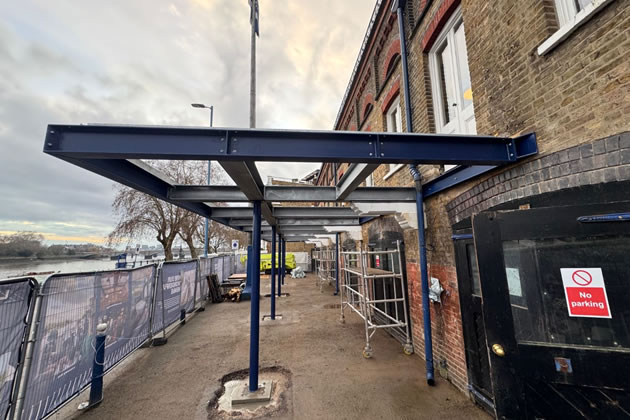
The project will allow the renovation of the balcony to proceed
|
January 27, 2026
A major programme of ground stabilisation has been completed at the historic London Rowing Club (LRC) on Putney Embankment, where weak soils beneath the clubhouse’s 104-year-old balcony prompted urgent intervention.
Ground engineering specialist Geobear was brought in to strengthen the foundations ahead of a planned balcony renovation, deploying more than 400kg of geopolymer resin to compact the underlying ground and improve its load-bearing capacity.
The London Rowing Club, founded in 1856, is one of Britain’s oldest and most decorated rowing institutions. Its riverside clubhouse, built in 1870, was the first purpose-built rowing venue on the Putney Embankment and has remained the club’s home for over 150 years. The club has produced generations of elite athletes, including Olympic gold medallist Phelan Hill, and continues to play a central role in the UK rowing community.
The embankment on which the clubhouse stands was created in the late 19th century through land reclamation, using a mixture of soil, rubble and construction waste to raise the riverbank above high-tide levels. While typical of Victorian engineering, these made-ground soils are prone to long-term settlement—particularly where the fill was poorly compacted. Over time, this has left parts of the embankment vulnerable to instability.
The club’s balcony, which has deteriorated with age, is now being replaced with a heavier structure, prompting the need for ground improvement works before construction could proceed. “Ensuring the safety and longevity of our clubhouse is paramount,” said Peter Halford, director at LRC. “Geobear’s solution allows us to address structural concerns without disrupting our daily activities or the club’s rich heritage.”
Geobear’s intervention involved drilling small injection points beneath the balcony’s new support columns and introducing an expanding geopolymer resin. As the material expands, it compacts the surrounding soils, increasing their strength without the need for excavation or heavy machinery. “Our process involves drilling small holes and injecting the expanding resin, which compacts and stabilises the made-ground soils without the need for excavation,” explained Halil Kaygisiz, area manager for commercial and infrastructure at Geobear UK. “It’s non-invasive and can be completed in a single day, allowing the club's rowing sessions and events to continue uninterrupted.”
The decision to appoint Geobear was influenced not only by the technical requirements of the site but also by the company’s reputation for transparent advice. Alex Fothergill, director at Fothergill Consulting Engineers and a long-standing LRC member, said: “I came across Geobear on another project, where Halil advised me honestly that theirs wasn’t the most cost-effective solution. I knew then that I could trust him and Geobear. In this case, it was clearly the right solution to allow the club to remain open while the works took place.”
With the ground now stabilised, the London Rowing Club can proceed with its balcony renovation—preserving the structural integrity of its historic home while ensuring it remains fit for purpose for future generations of rowers.
Like Reading Articles Like This? Help Us Produce More This site remains committed to providing local community news and public interest journalism. Articles such as the one above are integral to what we do. We aim to feature as much as possible on local societies, charities based in the area, fundraising efforts by residents, community-based initiatives and even helping people find missing pets. We've always done that and won't be changing, in fact we'd like to do more. However, the readership that these stories generates is often below that needed to cover the cost of producing them. Our financial resources are limited and the local media environment is intensely competitive so there is a constraint on what we can do. We are therefore asking our readers to consider offering financial support to these efforts. Any money given will help support community and public interest news and the expansion of our coverage in this area. A suggested monthly payment is £8 but we would be grateful for any amount for instance if you think this site offers the equivalent value of a subscription to a daily printed newspaper you may wish to consider £20 per month. If neither of these amounts is suitable for you then contact info@neighbournet.com and we can set up an alternative. All payments are made through a secure web site. One-off donations are also appreciated. Choose The Amount You Wish To Contribute. If you do support us in this way we'd be interested to hear what kind of articles you would like to see more of on the site – send your suggestions to the editor. For businesses we offer the chance to be a corporate sponsor of community content on the site. For £30 plus VAT per month you will be the designated sponsor of at least one article a month with your logo appearing if supplied. If there is a specific community group or initiative you'd like to support we can make sure your sponsorship is featured on related content for a one off payment of £50 plus VAT. All payments are made through a secure web site. |